Friday, March 24, 2017

Chinese once an influential force in Sonora, Mexico


Chinese restaurant in
Nogales, Sonora, Mexico
When the Chinese began immigrating around the world, many of them ended up in Mexico where they became an important economic and social force to be reckoned with. Many of them ended up in northwestern Mexico’s state of Sonora, which borders the U.S. state of Arizona.


By the early 20th century, Sonora was home to more Chinese than any other state in Mexico. But that changed a few years later when thousands were expelled from Sonora. The Chinese worked hard at local trade and businesses and set mew demands in these fields, according to Evelyn Hu-De-Hart who wrote a paper on the Chinese in northern Mexico.


Their successes did not set well with the Mexicans, who felt they could not compete with the industrious Chinese. Thus, the downfall of the Chinese began with the Mexican Revolution of 1910 where new leaders promised the Mexican masses an end to social injustices. The success and influences of the Chinese did not sit well under the new regime, and eventually led to them being dispelled. The Chinese never regained their influence.


In an ironic twist, when the immigrants newly arrived in China, they sometimes only found menial work that paid wages of about one-third of what Mexicans were paid. This, again, did not sit well with the Mexicans who said this led to them being exploited in the work place.


Some new Chinese immigrants were bankrolled by long-time Chinese residents to start their own businesses. This was usually something low on the totem pole, such as street vending. But they quickly grew into larger businesses, perhaps in truck farming, retail or manufacturing. At one time, the Chinese owned 10 of the shoe factories in Sonora.

Tuesday, January 10, 2017

Cock-a-doodle-do! The Year of the Rooster is coming

China celebrates the Year of the Rooster in 2017 when the Lunar New Year begins on January 28.
The rooster is the 10th animal in the Chinese zodiac. There are 12 animals in the zodiac with each one celebrated every 12 years. The next Year of the Rooster will be 2029; the last one was 2005. The number of days in a lunar new year varies, and is not the traditional 365 days on western calendars. The Year of the Rooster ends on February 15, 2018.

This is a special Year of the Rooster, one that happens only every 60 years. Lunar New years are based on elements: gold, wood, earth, water and fire. This is the year of the Fire Rooster. The last year of the Fire Rooster was 1957.  Fire Roosters are considered responsible workers, good timekeepers and trustworthy.

In general, roosters are considered hardworking, self-confident and talented.  They’re honest, outspoken and talkative. They like to be the center of attention.

Gold is a lucky color for roosters, but red, a traditional good luck color in China, is not. This year is considered an unlucky year for roosters, but they are expected to be lucky in the second, fifth and 11th months on the lunar calendar.

Famous roosters include Barry Bostwick, Cate Blanchett, Brittney Spears, Caroline Kennedy, Eleanor Roosevelt and Serena Williams.

NYT: best places to visit in 2017

Only one place in China made it to this year's best places to visit in 2017 list from the New York Times. In past years, several China destinations have been on the lists.

Sanya,  an island resort in South China, is known as the Hawaii of China. Located on Hainan Island, it's got tropical weather and super beaches. CNN singled out the many luxe resorts as one reason to visit.  It was No. 20 on the list.

As usual, luxury accommodations rate high as reasons to visit the newspaper's list of top destinations. newspaper's annual list of best places to visit.

Other dstinations inAsia that made the list were in Japan, South Korea, Thailand and Nepal.

Friday, January 6, 2017

Pandas, spicy food shine in Chengdu

Panda papercut
A city I southwestern China is the only Chinese city to make one list of the best places to visit in 2017.

CNN picked Chengdu because of its tasty Sichuan food and the opportunity to get up close and personal with pandas, a symbol of the Middle Kingdom.

Chengdu is one of UNESCO's cities of gastronomy. If you like your food hot and spicy, you'll love the food here.  When I visited Chengdu many yars ago, I had the best gongbaojiding (chicken in a spicey peanut sauce) I've ever had. It was also the spiciest and I drank four bottles getting to the last bite.

No visit to Chengdu is complete without a visit to the Giant Panda Breeding Center. I visited there in the early morning, a time when they feed the pandas.  There were no babies at the time I was there, but thee are usually panda cubs there a lot, due to the success of breeding this endangered species.

Chengdu also has lots of other interesting things to see. Some of the places I visited during my week-long visit were Du Fu's thatched cottage (Du Fe was a famous poet); the Wenshu Monastery, the best preserved Buddhist temple in the city where worshippers burned red candles instead of incense whicks while "Happy Birthday" played in the background;  and the old town.

Thursday, July 28, 2016

Pingyao a top destination with European visitors

Pingyao in 1997
A recent Global Times article lists Pingyao as one of the top 10 destinations in China for European travelers.

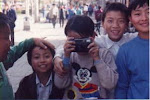
This walled Ming Dynasty city in Shanxi Province was one of my favorites when I lived in Beijing. Oh, how it's changed since then. A picture accompanying the article showed the street filled with people., and foreigners so rare that a couple of toddlers  ran away screaming when they saw me. One little boy was more adventurous and shyly followed me around and a couple of times acted as my "translator", even though he had no English.  He did keep his Chinese simple enough that I could understand it, especially the lecture from an elderly gentleman about being a single foreign woman traveling alone in China.

Back when I visited, Pingyao was just beginning to be discovered as a tourist destination. The streets were dirt, and I enjoyed wandering through them, looking at the old buildings. I then climbed to the top of the wall, walking around it and viewing the city below.

Pingyao is considered the best preserved walled city in China. Many movies, including Raise the Red Lantern, and television shows have been filmed here.

There weren't many surprises on the top 10 list, just the normal tourist destinations, such as Beijing, Shanghai nd Xi'an.

Wednesday, July 13, 2016

Shanghai, Hong Kong: top places to visit in Asia

Shanghai's Nanjing Street at night
Two cities in China have been named to Lonely Planet's list of top 10 places to visit in Asia in 2016.

They are Shanghai, No. 2, and  Hong Kong, No. 5, both major international cities drawing millions of tourists each year.

Shanghai is the financial capital of China and the country's largest city.  It made the list because the first Disney resort in China opened there in June 2016. This metropolis is a bustling city on the Haungpu Rive, so a walk along the Bund is a prime activity for visitors. Shanghai also has some of the most innovative architecture I've ever seen. It's particularly spectacular at night if you're taking a river cruise.

Hong Kong is famous for Victoria Peak and the Star Ferry, but the guidebook publisher picked it because of its great parks in the outlying areas.  The former British colony reverted to Chinese ownership in 1997.

Thursday, June 23, 2016

Jiading hosts Confucius temple, scholarly museum

Scene at Jiading Confucius Temple
China is home to many temples devoted to the ancient philosopher Confucius. One of the oldest and prettiest is located in a small water town near Shanghai.

Jiading isn’t on the well-known water town route that includes Suzhou and Tongli, which makes visiting here a treat as it’s not overrun by tourists. Jiading, though, was a flourishing town before Shanghai was barely  a gleam in anyone’s eye.

The Confucius temple here oozes peace and serenity, and barely shows its age. Constructed in the 13th century, it took 30 years to complete. It underwent 10 renovations by various dynasties, which is why it is so well-preserved today.

Study hall
Three bridges, with the traditional lion heads, cross a quiet canal into the main hall. A statue of Confucius surrounded by musical instruments and documents stands in the center of the hall.

The temple is next to the Confucian academy, which turned out nearly 200 imperial scholars over the centuries, thus earning Jiading the title of “state of education.” As you wander the academy grounds, you can see the doorless cubicles where scholars sat for their examinations. Today the temple is home to the Shanghai Museum of the Chinese Imperial Examination System. The examination system was used to select government officials.

The temple is a Shanghai Municipality Protected Historic Site.

The temple and academy are located at No. 183 Nandajie Street in Shanghai. Admission is charged.
 
Scholar at study


Wednesday, June 15, 2016

Three Chinese museums among world's most popular

Three museums in China made the list of the world's most popular museums in 2015, but they're not the ones you'd imagine.

Most people would put the Forbidden City, Great Wall of China, the Terra Cotta Warriors or, maybe, the Shanghai museum on the list of the 20 most popular museums in the world.  But you'd be wrong.

According to the TEA/AECOM Global Attractions Attendance Report for museums, the top museums in China are:
  • No. 2: National Museum of China, in Beijing, with  7,28 million visitors;
  • No. 8: Shanghai Science and Technology Museum, with 5.948 million visitors; and
  • No. 19: China Science and Technology Museum, Beijing, with  3.36 million visitors.
For the fourth year in a row, the Louvre Museum in Paris was the most visited museum in the world. It drew 8.7 million visitors in 2015.

Tuesday, June 14, 2016

Shanghai restaurant named one of world's best

China has racked up another international award, this time for restaurant food.

Ultraviolet, a restaurant in Shanghai, was just named No. 42 on the list of the world's 50 best restaurants It's also been named one of the best restaurants in Asia.

On its website, Ultraviolet describes itself as the first restaurant in the world to combine food with multi-sensorial technologies. This has resulted in dishes with such exotic names as Whales in Love and Scent of Seaweed Pacific Breeze in its 20-course meal.

Friday, May 27, 2016

Chinese theme/amusement parks among world's most popular

Five amusement parks in China and Hong Kong are among the world's top 25 most visited amusement parks.

More people than ever are visiting theme and amusement parks, with 2015 attendance up 5.4 percent over 2015. The CNN article was based on  the Themed Entertainment Association/AECOM 10th annual global attractions attendance report. Asian parks are seeing the most gain in attendance.

The Chinese and Hong Kong parks on the list are:
  • No. 25: Songcheng Lijiang Romance Park in Lijiang.
  • No. 18: Hong Kong Disneyland, which is no surprise since Disney parks get the most visitors anywhere. Toy Story is this parks top attraction.
  • No. 17: SongCheng Park. Located in Hangzhou, this theme park is dedicated to the Song Dynasty (960 to late \ 1200s).
  • No. 15: Ocean Park, a marine life park in Hong Kong.
  • No. 13: Chimelong Ocean Park in Guangdong Province.  Visitors get close-up views of marine life as they walk through a transparent underwater tunnel

Saturday, May 7, 2016

Chinese touches accent Frank Lloyd Wright's Taliesin West

Ceramic Chinese actors decorate posts.
The central Arizona desert is about the last place I expected to see Chinese influences outside of Chinese restaurants, But that’s just where I found them, at Taliesin West, an architectural masterpiece designed by Frank Lloyd Wright, the greatest American architect of the 20th century.

The lines of his winter home and school of architecture are clean and pure. Wright’s designs are inspired by nature. Local rocks were turned into walls held together with concrete. The surfaces are rough and coarse, yet seem elegantly in sync with the desert surroundings. The Chinese decorative touches blend in perfectly, not feeling out of place at all.

Scattered throughout Taliesin West, beginning with the entrance, are 13 Chinese theatre scenes that sit in the middle of concrete and rock posts. The scenes represent the various dramas of the Chinese Imperial Theatre.

The scenes are incomplete; our guide says they were broken when he bought them. Architectural students pieced them together and glued them into the concrete. The glue they used, however, didn’t make it through the wet season; pieces fell off and broke. They were replaced.
 
Dragon head atop roof
As you tour this amazing facility, you’ll come across a dragon‘s head sitting atop a slanted roof. The dragon is a symbol of China.

At another place, you’ll find the traditional bright red door centered with an ornate gold door opener. Just to the right of the door is a huge black gong.

Frank Lloyd Wright bought land n the desert and began building Taliesin West in 1937; he was still working on it when he died in 1959.

 The lines of his house are sleek – and slanted. Clerestory windows let in light from the desert sun. The buildings had features that were so architecturally advanced, it would be decades before they become commonplace. The setting is magnificent, with a backdrop of mountains behind and desert as far as you can see from the front.

 Guided tours of Taliesin West are given throughout the day. You may wish to reserve a time before you arrive as tours fill up quickly on some days. Taliesin West is located north of the intersection of Cactus Road and Frank Lloyd Wright Boulevard.


Taliesin West


Wednesday, April 27, 2016

Two Chinese bridges among world's most incredible bridges

Two bridges in China are among 11 bridges that are considered the most incredible in the world.

The bridges, listed in a CNN article, are works of art as much as a way for people and vehicles to get from one place to another.

Both Chinese bridges on the list have not opened yet, though one, Zhangjiajie Canyon Bridge is scheduled to open in May 2016. Designed by Haim Dotan, it will be the largest glass bottom bridge in the world. At 68 feet long and 718 feet high, the bridge will be used for bungee jumping as well as host fashion shows.

The Lucky Knot Bridge at Changsha is scheduled to open later in 2016. Red knots are said to bring good luck in China. Designed by NEXT Architects, the bridge, which is red, resembles the decorative Chinese knots, only a whole lot bigger.

Friday, April 22, 2016

Chinese park among world's best national parks

A park in China made the list of the 30 best national parks in the world. The list was compiled by Colorado travel writer Anne Dirkse. The article was originally published on CNN in 2014, but CNN recycled it for Earth Day 2016.

The lone Chinese park on the list is Zhangjiajie Forest National Park in southcentral China's Hunan Province. The park is famous for its pillar-like rock formation that were formed by erosion.

Spread over 50 square miles, some of the rock formations are topped by trees; some 500 species of trees can be found in the park, as well as a variety of wildlife, including monkeys and birds.

The park started out as a tree farm in 1958 and became a national park in 1982.  It is on the list of UNESCO's World Geoparks.

Monday, April 4, 2016

Beijing's airport one of world's busiest

Flying over northeast China
en route to Beijing
It should come as no surprise to anyone who's ever flown into Beijing that the city's Capital International Airport is one busy place. If fact, it's the second busiest airport in the world, handling nearly 90 million passengers in 2015.

The label of world's busiest airport again went to the United States' Atlanta Hartsfield Jackson International Airport, which processed more than 100 million passengers in 2915, according to a CNN article based on traffic data from the Airport Council International.

No. 8 on the list is Hong Kong International Airport with 68 million passengers. Hong Kong also was named the world's busiest cargo airport. Shanghai was the third busiest cargo airport in the world in 2015.

Thursday, March 31, 2016

China library among world's 'most exquisite'

An ancient library in China was named one of the most exquisite libraries in the world.  The Ningbo library ranks up their with libraries from mostly Europe and the United States. Only one other library in Asia, this one in South Korea, made the list of 15 libaries.

The list, which was featured in a CNN article, was compiled by Dr. James Cambell of Cambridge University from his book: The  Library: A World History.

The Tianyi Chamber in Ningbo dates back to 1561, making it the oldest surviving library in China.  The library is dark inside; patrons were expected to choose a book and then take it outside to read.

The Tianyi Chamber boasts 300,000 books, of which 80,000 are considered rare,  though it had  only about 13,000 books when the People's Republic of China was founded in 1949. The books had either been stolen or destroyed. The collection, started by an official who liked books, has since been restored.

The library is located beside Ming Lake in Ningbo, a city in East China's Zhejiang Province. The library is open to the public; an admission fee is charged.

Tuesday, February 2, 2016

Chinese cities draw millions of international visitors

Shanghai shopping center
China may have strict visa require-ments, but they don't stop visitors from entering the Middle Kingdom.  Tourism is a booming business there, with the country putting five cities on a CNN list of the world's most visited cities in 2014. Travelers flocked here for both business and pleasure.

Whether China will have that many visitors in the following years remains to be seen. Major cities are battling heavy pollution, a deterrent to pleasure travelers.

Shanghai, the largest city in China and growing even larger,  ranked No. 20 on the list. International visitors are up, too, to 6.4 million in 2014.

Even more international visitors came to Guangzhou, once known as Canton. The city counted 8.2 million visitors in 2014, to rank at No. 16.

Shenzhen used to be a small sleepy town back in the 1980s, CNN notes, but that's all changed today. In 2014, this economic hub welcomed 13.2 visitors.

No. 6 on the list was Macau, the former Portuguese colony that returned to China in the late 20th century. It's known as Las Vegas of the East because of its over-the-top casinos. International visitors totaled 14.97 million in 2014.

Leading the list is Hong Kong, with 27.77 million visitors making it the world's most visited city in 2014. This is 10 million visitors more than London, which ranked No. 2.

Friday, January 29, 2016

The Year of the Monkey is coming!

Art from Aaron Hudson
Are you a monkey?

You are if you were born between February and the following January every 12 years beginning in 1908, which is within many people’s lifetimes. This year is actually the 4713th year that Chinese New Year has been celebrated.

The Year of the Monkey begins February 8. According to the zodiac calendar, the Year of the Money has started as early as January 22 and as late as February 20, in the last century. Chinese New Year starts on the first day of the first lunar month, and generally falls between January 21 and February 20. It is the biggest holiday in the Chinese calendar.

The monkey is the ninth animal in the Chinese zodiac, sandwiched between the sheep and the chicken.

Each animal in the zodiac is said to have special characteristics, and the money is no exception. People born in this year are said to be clever and intelligent, but at the same time they have strong tempers and are impetuous. While they are sociable, innovative and enthusiastic, they can also be suspicious and arrogant, and look down on others. When it comes to love, a monkey’s best matches are people born in the years of the ox and rabbit, but won’t have happy relationships with those born in the years of the tiger and pig.

Moneys won’t have smooth sailing this year. They need to be cautious and prudent, especially with investments.

Famous people born in the year of the monkey include Chinese basketball player Yao Ming, the Tang Dynasty’s Empress Wu Zehan, Celine Dion, Charles Dickens, Annie Oakley, Eleanor Roosevelt, Mick Jagger and George Lord Byron.

Sunday, January 10, 2016

China gets two spots on NYT's annual travel list

Traditional Chinese tiled roofs
Travelers planning to visit China in 2016 may want to consider Hangzhou and Guizhou. two places that made the New York Times annual list of places to visit in the coming year.

Hangzhou, home of the very scenic West Lake that inspired painters and poets, made the list for a number of reasons. including its booming economy. The city is home to several e0commerce biggies, such as Alibaba. More importantly, it is the first city in China to host a G20 summit. The city is adding new hotels and museums. One, the Folk Art Museum, is built on a former tea plantation. It features thousands of traditionally-styled roof tiles,as shown in the Times' accompanying photograph. Hangzhou ranked 16th on the newspaper's annual list.

Guizhou Province is just now being discovered by tourists, according to the Times, which notes a new high-speed train from Guangzhou reduced travel time from 20 hours to four. But it's a place that I fell in love with when I visited it 20 years ago. A visit to a minority village is a must; the Miao one I went to in the mountains was in the middle of rice harvest. (The photo of rice fields the Times used is stunning.) The village was rustic, set on hillsides. While there, I watched a man bath a water buffalo in a creek, which also served as a source of drinking water for the village. It's No. 44 on the list, but had I been making the choice, I would have put it much higher.

Monday, December 14, 2015

Beijing offers beautiful ice skaing

Shichahai Lakes in the summer
The three lakes in central Beijing have been named one of the 10 most beautiful places to ice skate during the winter in the world.

CNN recently compiled a list that includes Red Square in Moscow and Lake Louise in Banff, Alberta, Canada.

The article notes the lakes --, Houhai, Qinghai and Xihai, known collectively as Shichahai -- offer ice skating in a rink that is surrounded by historical architecture. The phoeo they used with the brief explanation shows the Drum and Bell towers, two Beijing landmarks, in the background.

While the lakes are bluely serene in the summer, they freeze over in the winter. Many people ice skate wearing every day shoes,, while others wear regular ice skates. They also push each other around on metal chairs.

If I were compiling the list, I also would have included Kunming Lake at Beijing's Summer Palace on the list. It's another popular place with ice skaters who can look up to Longevity Hill while they're on the ice.

Saturday, July 11, 2015

Site in China joins UNESCO World Heritage list

China landed one site on UNESCO's World Heritage list for 2015; 24 sites from around the world were added to the list this year.

The international organization recognized the Tusi in the mountains of southwest China. The area is noted for its form of tribal government that existed from the 13th to the 20th centuries. The Tusi were hereditary rulers from several tribal or minority domains. The Tusi system can be traced back the third century BC.

"Its purpose was to unify national administration, while allowing ethnic minorities to retain their customs and way of life," UNESCO says.

Laosicheng, Tangya and Hailongtun Fortress are included in the new World Heritge site that was announced on July 4.